
Key takeaways
- Yes above RM1 million. Below it, the honest answer is that nobody has shown us the paperwork. Johor prices an approval for serviced apartments sold under that figure, so the category is real. What we could not find is a document naming a project or a unit. Get that in writing before you pay anything. No visa programme is involved either way, and other routes below RM1 million carry conditions of their own.
- Only new strata units, bought straight from the developer, inside Medini. Resale does not work the same way. Landed does not either.
- The Malaysian Bar’s own state table does not record this exception. Read that section before you trust anyone, including us.
- The state consent fee on a sub-RM1 million serviced apartment starts at RM50,000. On a RM299,000 unit, government costs come to about 25% of the price. Run your own figure through the full cost breakdown to see every fee and when each one falls due.
- Medini is leasehold, not freehold. If freehold matters more to you than entry price, this route is not for you.
The short answer
Buy anywhere in Johor on a foreign passport and you meet a RM1 million floor.
Below that figure it gets interesting, and this is roughly where most guides stop being careful.
Johor’s own fee schedule carries a line for a serviced apartment or SOHO that the state has approved for sale under RM1 million. It even prices the approval. So the category is real, and you can go and read it yourself.
What that line never does is name a project.
We went looking for a document that puts Bodaiju, or Medini as a whole, or one specific unit inside that category. We did not find one. The market talks as though it is settled for the entire zone. We cannot show you the paper that settles it, and so far, neither has anyone else.
So it is a question about your unit, answered in writing, before money moves. Not a question about the postcode.
Two other routes people ask about, each carrying a condition of its own:
- Forest City has its own Special Financial Zone route, reported to start near RM500,000, but it runs through the MM2H residency programme, so you clear that hurdle first.
- Individual projects have at times won their own state approval for selected units. That is a decision about one development, not a rule you can lean on in advance.
The rest of this page is about where the edges are, what it costs you to stand inside them, and what to ask for in writing before you pay anything.
If the question behind your question is whether Johor has too much of this stock already, we have answered that one separately, from NAPIC’s own unsold-property tables.
The rule everyone quotes, and why it is only half true
Foreign ownership of land in Malaysia runs through section 433A of the National Land Code. Each state then sets its own minimum purchase price.
The Malaysian Bar publishes the full state list in Circular No 444/2024 on restrictions for non-citizens, dated 23 December 2024. For Johor it says:
Direct purchase from developer / subsale: 1,000,000.00 and above
But RM1 million is not a national number.
Perlis and Kelantan sit at RM500,000. Penang splits its floor by property type and by whether you buy new or secondhand, going as low as RM400,000 for some apartments on the mainland. Kuala Lumpur is at RM1 million, which is probably why so much Kuala Lumpur advice gets repeated as if it were the law everywhere.
Some categories are closed to foreigners at any price. Auctioned property is off limits in several states. So is Malay reserve land, and Bumiputera quota and low-cost housing. In Johor, single storey terrace houses are off limits too.
What Medini is said to change, and what the sources actually say
Medini is a zone inside Iskandar Puteri, set up under the Iskandar Regional Development Authority with its own investment incentives, and how Medini is organised is a separate question from what you may buy in it, and it sits inside the Johor-Singapore Special Economic Zone. The claim made for Medini is that one of those incentives lifts the RM1 million floor for new strata homes bought straight from the developer.
That is the claim. Now the awkward part, which you will not find on the other guides.
The Bar circular does not mention Medini anywhere. Its Johor row reads RM1 million flat, new and resale alike.
You would find that out eventually, so you may as well find it out here.
The circular can show exceptions when it wants to. It does exactly that for Penang, splitting developer sales from resales at different floors. For Johor it drew no line at all.
Here are the two rows side by side, as the circular sets them out.
| Circular No 444/2024 | Penang, island | Johor |
|---|---|---|
| Strata, direct from developer | RM700,000 | not distinguished |
| Landed, direct from developer | RM1,500,000 | not distinguished |
| Strata, subsale | RM1,000,000 | not distinguished |
| Landed, subsale | RM3,000,000 | not distinguished |
| What the row says | Four brackets, split by tenure route | One line: RM1,000,000 and above, developer and subsale alike |
In fairness to the Bar, its own footnote says the table is for information only and should not be treated as accurate or authoritative. It is a desk reference for practitioners, not the instrument that creates or cancels a zone incentive. So its silence is not a denial.
The better corroboration comes from the state itself, in the Johor Land and Mines Office fee schedule. Buried in the foreign acquisition fees is a separate minimum for “servis apartment / SOHO yang dibenarkan jualan bawah had harga minima RM1,000,000.00”, meaning serviced apartments permitted to be sold below the RM1,000,000 floor.
Johor charges a specific fee for a category it says exists. Governments do not price things that cannot happen.
So the rule is real. What is not automatic is whether your unit falls inside it.
That is the distinction worth holding on to, because the two get blurred constantly. The exemption existing is a question about the zone. Your unit qualifying is a question about your unit.
Which is why the only sensible thing to do is check the second one yourself. Ask the developer’s solicitor for the written basis their project relies on, by name: the IRDA or Medini incentive approval, and the state consent correspondence that reflects it. Then have your own solicitor read it before you pay a deposit.
If nobody will put it in writing, that tells you something on its own.
What qualifies, and what does not
Three things have to be true at the same time:
- it is a new strata unit, not a house on its own land
- you buy it straight from the developer, not from someone who already owns it
- it sits inside Medini
Break any one of them and the RM1 million rule applies. Meet all three and the question is still open: it moves from the zone to your specific unit, and only the developer’s solicitor can answer it in writing.
Buying secondhand is a different question. If you buy a cheap unit from an existing owner rather than from the developer, do not assume the same answer. This is the mistake we see most often.
An Iskandar Puteri address is not enough on its own. Medini is a specific zone, not a general area. Nusajaya, Puteri Harbour, Gelang Patah and Bukit Indah are not Medini.
The road signs make the point better than we can.
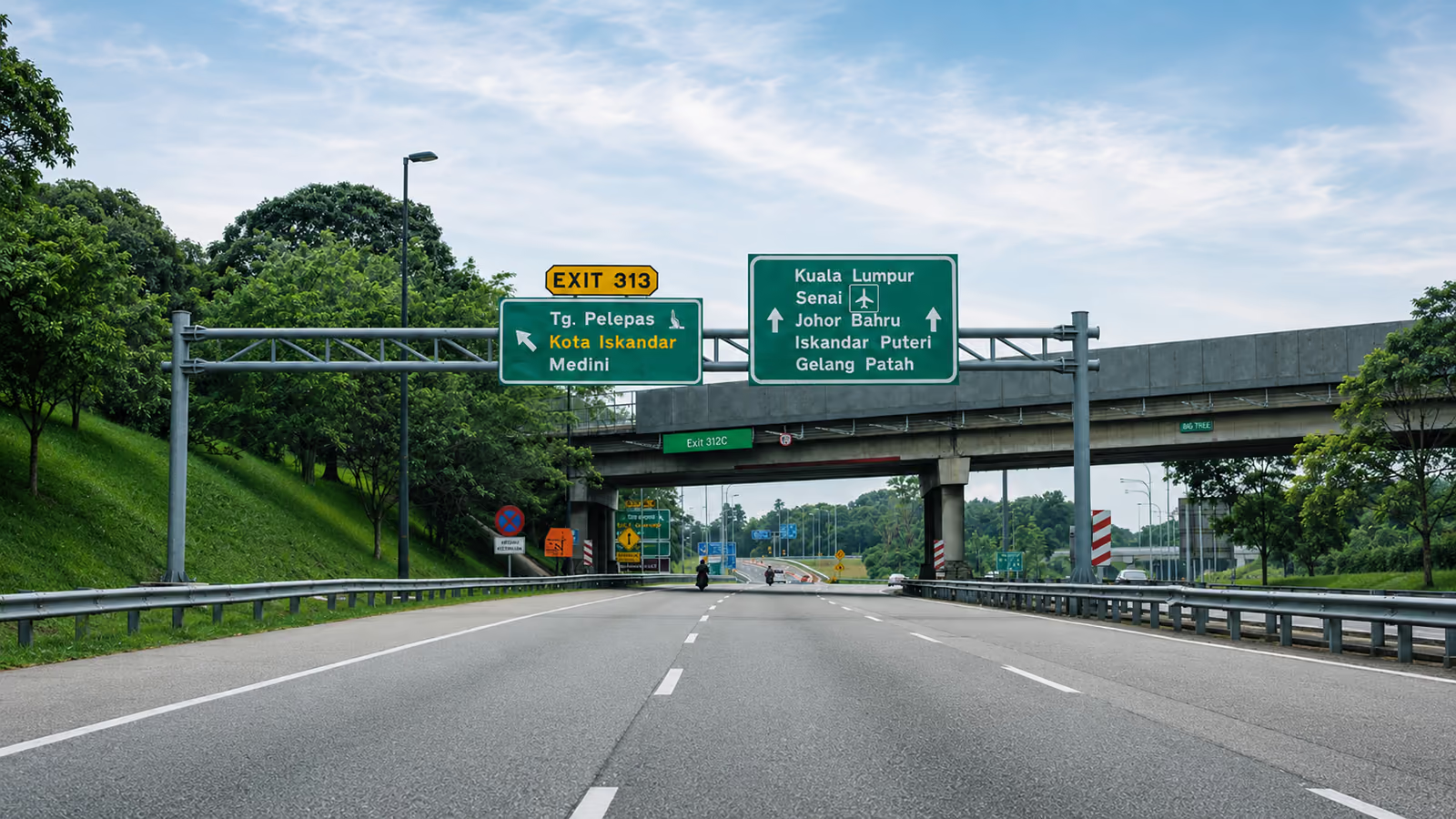
Check the land title, not the marketing.
The cost nobody puts in the brochure
Clearing the price floor is the start of the sum, not the end. This is the part that changes people’s minds, so we have shown the whole arithmetic rather than a summary of it.
Under the Johor Land Rules (No. 1) (Amendment) 2026, in force from 1 April 2026, the state’s published schedule of foreign acquisition fees reads:
| Item | Amount |
|---|---|
| Application for consent | RM2,000 per title |
| Approval fee, buying from the developer | 3% of value, minimum RM30,000 |
| Approval fee, serviced apartment or SOHO sold below the RM1m floor | minimum RM50,000 |
| Approval fee, buying on a subsale | 3% of value, minimum RM30,000 |
| Approval fee, industrial | 4% of value, no minimum |
| Registering the transfer, by price | RM600 to RM4,500 below RM1m |
| Appeal against a rejected application | RM3,000 per title |
| Late payment penalty | RM2,000 per title |
The rates sit in Schedule 6, Arrangement V of the Johor Land Rules 1966. The Land Director circulated them to the Johor Bar Committee on 13 March 2026 under reference PTG(D)15/3/35(26), after the State Authority approved them on 25 February 2026, with a transition period that ran to 30 April 2026.
One line there is worth reading twice. In the gazetted schedule the RM50,000 sentence sits inside the entry for buying from the developer, and the subsale entry below it carries only the RM30,000 floor. The state’s own summary page states the RM50,000 minimum without that qualifier. So whether a future foreign buyer of your unit faces RM50,000 or RM30,000 is not settled on the face of the schedule. Get a written answer from your own solicitor rather than assuming either way.
A serviced apartment under RM1 million lands in the RM50,000 bucket. Three per cent only overtakes RM50,000 once a property passes about RM1.67 million, so at these prices the flat minimum is simply what you pay.
On the cheapest unit at Bodaiju that works out like this.
| On a RM299,000 unit | Amount |
|---|---|
| Application for consent | RM2,000 |
| State consent fee (3% would be RM8,970, so the RM50,000 floor applies) | RM50,000 |
| Registering the transfer | RM600 |
| Stamp duty at 8% | RM23,920 |
| Total government cost | RM76,520, about 26% of price |
On a RM659,000 unit the same four items come to RM107,720, about 16%.
The cheaper the unit, the worse the percentage, because RM50,000 is a flat floor rather than a rate. That is the opposite of what most buyers assume.
None of that includes legal fees, valuation, or the loan.
What else you still pay
| Item | What a foreign buyer pays |
|---|---|
| Home loan | Usually 60% to 70% of value, against up to 90% for Malaysians |
| Tax on resale | 30% within five years, 10% from year six, and it never reaches zero |
| Held back at sale | 7% of the disposal price |
Four things in that table are worth pulling out, roughly in the order they will hit you.
The loan cap reshapes the budget. If the bank lends 60%, you find the other 40% in cash, where a Malaysian buyer finds 10%.
The stamp duty date is the transfer, not the booking. The 8% comes from the Finance Act 2025. It applies to non-citizens excluding permanent residents, and it bites on the date the transfer instrument is executed. A 2025 booking that transfers in 2026 pays the 2026 rate.
The resale tax never reaches zero. The rates sit in Schedule 5 of the Real Property Gains Tax Act 1976. A Malaysian holding past five years pays nothing. A foreigner still pays 10%, however long they hold. That rate, the buyer’s 7% retention and the question of who is actually left to buy from you are worked through in what selling a Medini apartment again really costs a foreigner.
CPF savings cannot be used for a Malaysian property either, in the CPF Board’s own words, so a Singapore buyer is working with cash plus a Malaysian mortgage.
Put the loan and the fees together and you get the number that actually decides whether you can buy.
A RM299,000 home asks a foreign buyer for roughly RM196,000 in cash. A Malaysian buying the same unit, at 90% financing, with no consent fee and a lower stamp duty rate, is looking at a fraction of that.
Test your own budget against that figure before you go any further. Everything else on this page is detail by comparison.
Can foreigners buy freehold property in Malaysia?
Yes. Malaysia lets foreigners hold freehold title, which is unusual in this region, and plenty of foreign buyers do exactly that.
Just not through this route.
Medini is leasehold. What you buy is a long lease, not the land itself, under the private lease scheme set out in how tenure at Bodaiju actually works.
That structure has been tested in court. On 29 April 2025 the Court of Appeal ruled in favour of Tropika Istimewa Development, the developer of The Meridin @ Medini, against 107 buyers (a solicitors’ note on the judgment sets out the reasoning). It held that strata titles issued under Medini’s long-term lease are valid and do not contravene the National Land Code or the Strata Titles Act, and that the Medini property regime was expressly designed to operate on a private lease model.
So it stands up. But it is a real trade-off, and you should know you are making it.
If owning freehold matters more to you than the entry price, this is not your route. Look at freehold stock above the state minimum instead.
Cheap enough does not mean you skip consent
This is where most people misread the exception.
The Bar circular is blunt about it:
State Authority’s consent must be applied and obtained by each foreigner purchaser in all States in order to acquire properties.
Coming in under the price floor does not put you outside the consent process. It only changes which fee bracket you land in, and as the table above shows, it lands you in the more expensive one.
Your solicitor applies after you sign the sale and purchase agreement. The title cannot move into your name until it is approved.
Buying a home does not get you a visa
Search this question and Google will happily serve you pages selling golden visas. So, plainly:
Buying property in Malaysia does not give you residency, a visa, or citizenship.
Malaysia My Second Home is a separate programme with its own financial criteria, run by the tourism ministry. You do not need it in order to buy, and buying does not get you into it.
| Buying a home gives you | It does not give you |
|---|---|
| Registered title in your own name | Residency or a long-stay visa |
| The right to sell, subject to RPGT | A work permit |
| The right to let it out, subject to the building's rules | Any path to citizenship |
| The right to pass it on by inheritance | Automatic MM2H eligibility |
If the right to stay long term is the actual goal, treat it as its own application.
What this looks like on a real project
We sell at Bodaiju Residences, so treat this as a worked example rather than a recommendation.
It is 802 homes in Medini, built by Creed Group of Japan, about 9 km from the Tuas Second Link. It is the shape of purchase described above: new strata, bought straight from the developer, inside Medini.
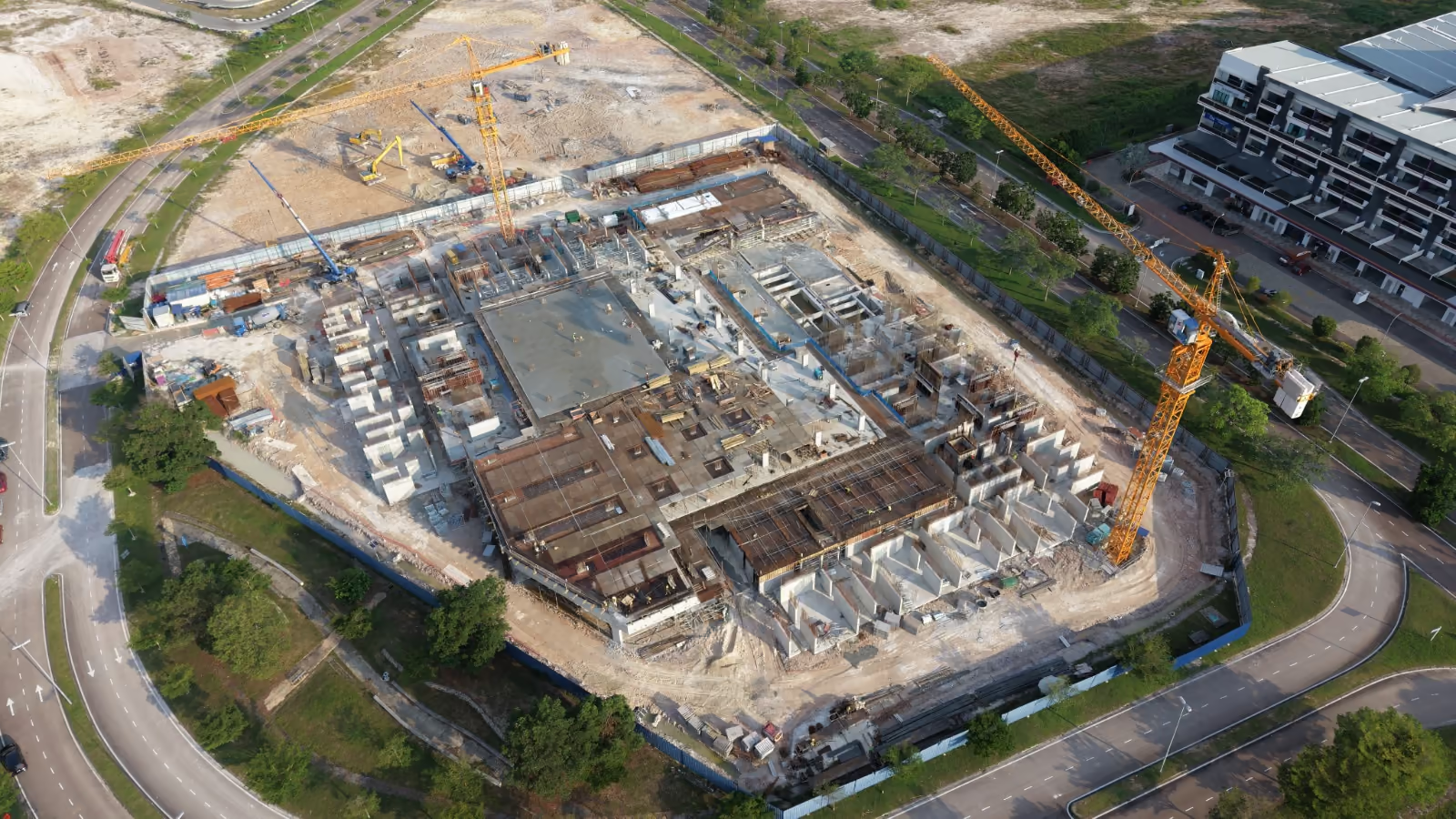
| Bodaiju Residences | At a glance |
|---|---|
| Homes | 802, in two towers |
| Tower A advertising range | RM299,000 to RM659,000 |
| Layouts | 463 to 1,012 sq ft |
| Tenure | 99-year leasehold serviced apartment, from 2015 |
| To the Second Link | About 9 km |
| Developer | Creed Group, Japan |
| Contractor | MGB Berhad (Bursa-listed) |
| Zone | Medini, Iskandar Puteri (JS-SEZ) |
The entry-priced units were taken up first, so ask for the current price list rather than working off a published starting price.
Three banks have approved end financing: Bank Islam, Bank Muamalat and RHB.
The towers are still going up, as the photograph above shows. Anything you see of the finished building, here or anywhere else, is an artist’s impression.
Moving a family across changes the shortlist, because the school matters more than the layout. Start with the six international schools near Medini.
Five things to ask for before you sign
You can check nearly all of this yourself, without taking anyone’s word for it.
- The licence and permit numbers. Verify them yourself at teduh.kpkt.gov.my.
- The title particulars. Enough to run your own land search on the parcel.
- The written basis for the exemption. The actual document, for that specific project.
- A written quote for the consent fee. On your unit, including the RM2,000 application and the registration fee.
- The lease terms in the SPA. Read by your own solicitor, not the developer's.
A seller who is relaxed about all five is a seller worth continuing with. One who is not has told you something.
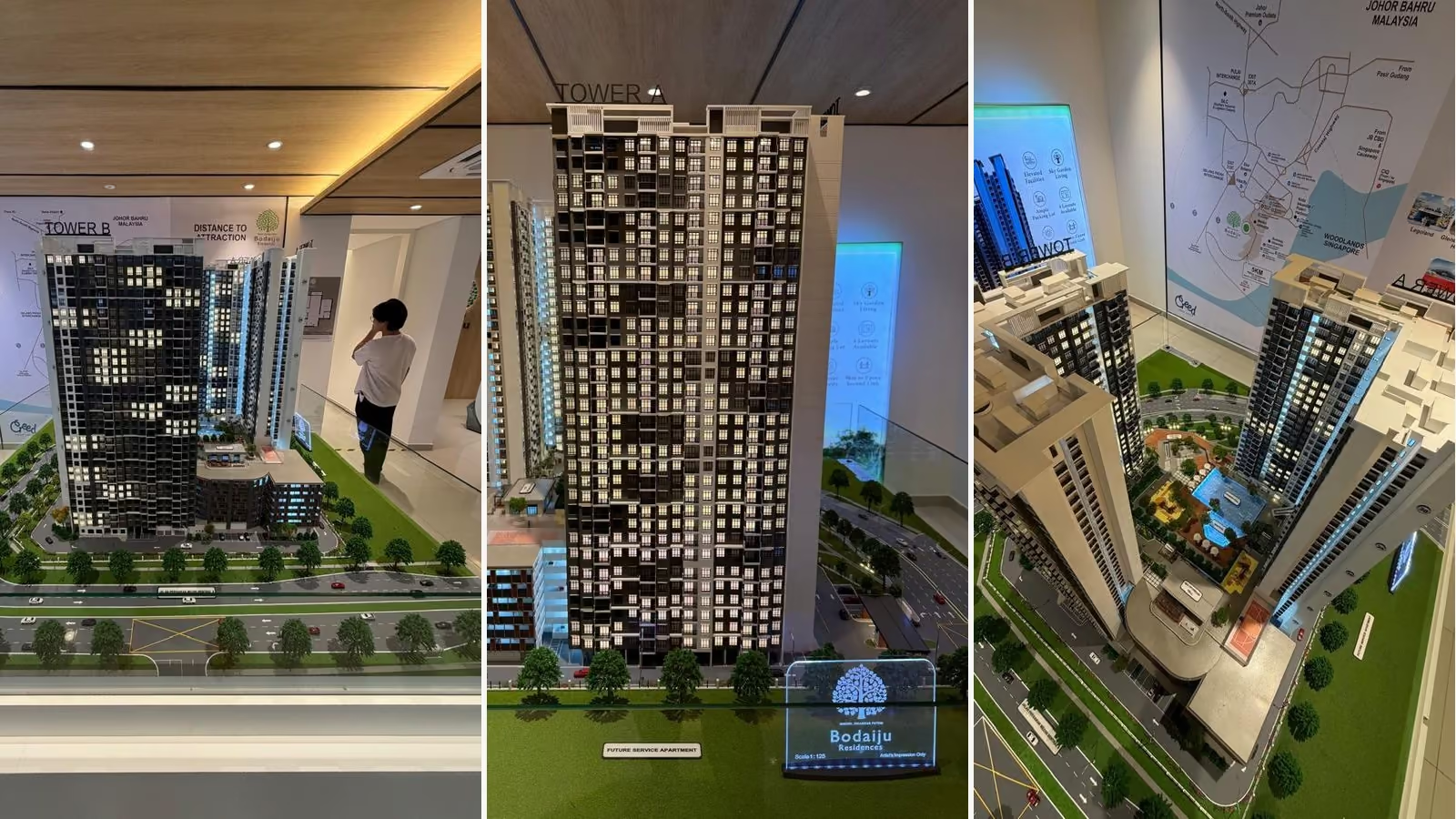
The licence and permit numbers are checkable in a minute at the national housing portal, teduh.kpkt.gov.my.
A viewing from Singapore is a half-day round trip. Book a private viewing and bring the list.
Written by Ivy Cheng, who sells at Bodaiju Residences in Medini and works on these transactions from Johor Bahru. The rules on this page are sourced to the Malaysian Bar’s Circular No 444/2024, the National Land Code, and the Johor Land and Mines Office fee schedule under the Johor Land Rules (No. 1) (Amendment) 2026. This is general information, not legal advice. Confirm the consent fee and the basis of the exemption with your own solicitor for your specific unit.